Thursday, 31 October 2019

Representation Practise Essay- DOC MARTIN

DOC MARTIN

This clip undermines gender stereotypes: it undermines the strong convention of females being represented as quiet, domestic, housewives, who thrive from the appreciation given from men. Here women are being represented as smart, independent, assertive individuals. 
Likewise the clip undermines the philosophy that men are biologically subject to objectifying  woman. Instead this notion is flipped on its head, portraying men as caring, compassionate beings. 
The upper class of  Bitish society are being portrayed as wealthy, and subjects too auspacious copacious living environments, and proffessional jobs. Such elevation should be questioned, and the lack of other social/ economic groups suggests an incompetencey of representing all peoples. Furthermore this representation of the higher classes may ellude to the fact that the media is most influenced by those who possess higher affulence. 

Feminity is portrayed primarily through one strong, audacious, young, attractive woman. We are first introduced to her through a middle adged man's eye line match, signifying the male dominance. The mid shot resembles a pituresque view of the young woman with a Mis- en-scene of her in a fitted light peachy coloured cardigan, (costuming) in a bright serene light. At first it appears that the scene is portrayed through a 'male gaze' as Mulvey dictated. However, the next edits comprise a shot reverse shot of subsequent mid shots between the famale and male, progressing to shot reverse shots of close ups, enhancing and focusing in on the womans' unsettled shifty eyes as the man incessantly stares at her. Tension is also built through mystifying stringed music hightening in pitch, to likewise unnerve the audience. The music undergoes an ubrupt cut as the young woman blurts out ' youve got a promblem!'.

Tuesday, 24 September 2019

Research- AUDIENCES


Introduction to an Audience
1. A) Define the terms target audience, niche audience and mass audience
     B) Give an example of films that were made for each of those audiences

Target Audience: a specific group of customers most likely to respond positively to your promotions, products, and services (in this case you film/media product). It is fairly broad and targets a large bracket of customers who may be interested. For example, your target market may be based off demographic groups such as age, gender, incomes, geographical location etc. Defining your target audience is about establishing relevancy. If what you offer and the media you present match what your audience is looking for, you’ll be more likely to gain a customer. A movie produced for a target audience would be Despicable Me.


This movie was generated for the genre of children which is a broad specification of the demography of age. 

Niche Audience: A niche audience is a subgroup of a company’s main targeted audience. This specific audience is a selective group of people who have specific wants, needs and interests. Niche audiences are so valuable because they are often more engaging, and attract a response in users due to the fact that the product are tailored specifically to them. The media is increasingly zeroing in on precisely defined racial and gender groups. In doing so they cut advertising costs to such a wide audience, and are more able to successfully lure their specified audience in ways that are appealing to that category of people. For example the movie, The Duff is targeted specifically at teenage girls. This specialization of both age and gender allows the produces to analyze exactly what their market preferences are. The trailer of the movie may have been projected before YouTube clips, considering that a lot of teenagers watch YouTube. If other audiences such and older women and men viewed this movie also, then the movie studio would have counted this as an extra, and would have been majorly relying on the movies success within teenage girls. 


Mass Audience: A wide audience that is comprised of many subgroups, such as differentiated niche audiences that are all subject to watching and engaging with one product of the media. The size of audiences for the same content in any mass medium has been dramatically reduced with the widespread diffusion of technological developments such as the web and satellite broadcasting. Achieving a mass audience has become increasingly hard due to the diversity of choice and specialized media content. Movies that have achieved such mass viewings are called mainstream or blockbusters. One may include the movie Aquaman (2019) receiving worldwide returns of $1,146,894,640, with a production budget of only $160,000,000. Its genre was action/adventure and its rating was PG-13. This is a movie that attracted a wide audience including families, teenagers as well as adults of both males and females. 


2.  Name and define the generations for audience study (Gen Y, Millennials etc.)
3. Think about the culture and world each generation is growing up in and analyze how you think technological developments may impact on their viewing habits and how they consume media (provide examples).


Baby Boomers (1946-1964)

Consumerism and size of market:

The generation that often gets overlooked is that first one—baby boomers! This generation was aroused by the boom in births following World War II. After the war finished, families wanted to restore order and a sense of stable normality and the solution for this was found in raising families. This resulted in the arise of the Baby Boomer generation. (Qu2)
When it comes to the 50+ demographic, only 10% of marketing budgets are used to reach this generation. With a population of 111 million, the 50+ demographic is the number 1 consumer-age demographic in the world. This sizable group will increase by 16 million over the next decade, more than triple the pace of younger demographics. In fact, not only are Boomer numbers growing exponentially, but they are living longer, better and more youthful than any of their predecessors. Retirement homes, for example, are providing more and more activities catered for the ever thriving, social network of the older generations. In America, 63 percent of all financial assets are owned by Baby Boomers, making them a serious economic force to be reckoned with. The 50+ generations accounts for half of all consumer expenditures, so overlooking the 50+ demographic is a major marketing mistake.

Trends in Media Consumption and Key Characteristics:

Baby Boomers are known for sticking to their roots, but are surprisingly open to new formats. of media networks. Baby boomers were raised in an era where resourcefulness was a necessary trait. Many of their parents lived through the Great Depression. Adapting to any new available resources and scrapping together very limited resources became normalised. This is why this generation who started off their lives with limited technology, has become quickly adapted to current changes in society and technology. As such, this generation can squeeze every ounce of usefulness out of the online activities, exercises, and tech tools. 

Unlike more recent generations, baby boomers know how to keep their minds focused on a particular subject or topic. They have amazing attention spans, which enables them to stay on track when they are engaging with media sources. This also means that they may take a bit more time with an online context such as news websites, recipes instructions etc., as they painstakingly pay attention to every detail. 

Another of the Baby Boomers' strongest characteristics, is their strong sense of community. They thrive in social, team orientated environments. This is partly why they are adapting faster and faster to technological networks that provide social interaction such as Facebook, Twitter, and Instagram etc. 

According to a study by Google, boomers and seniors spend more time online than they do watching TV. 82% of boomers who use the Internet have at least one social media account. As of 2017, about 75% of baby boomers actively use Facebook. Furthermore, out of its two billion monthly active users, 10% are boomers, while only 3% are from the younger demographic.

Despite Baby Boomers' quick adaptation, they have been proven to be very selective in the use of new and emerging technologies. This generation is very interested in assisting technology such as personal assistants and connected intelligence that are aware of their needs and improves their daily lives. They are unsurprisingly more cautious in adopt new technologies, particularly those which have a profound impact upon traditional approaches to interaction. Google statistics present that only 15% of Baby Boomers perceive new technologies as a beneficial advancement.

In advertising to Baby Boomers, in order to get their attention, it is best to cater to them visually through videos. Boomers are more likely to act on what they see online and are more likely to respond to product and service advertisements. According to the Google study, three of every four online video watchers have taken action after watching a video. They are therefore one of the most responsive to advertising, and leaving out Baby Boomers in promotional efforts would be far from wise. 

 Marketing to Boomers (Qu4)

In order to successfully capture senior audiences, the best way to do so would be through visually simplistic videos. This is because Boomers often struggle with information overload when it comes to watching things online. Facebook is the biggest online network being used by Boomers so if I were to advertise my filming to Baby Boomers, I would pay to advertise film trailers into Facebook YouTube is also the number one site that Baby Boomers stream videos off. Furthermore, YouTube videos are integrated into a diverse array of other network platforms such as Instagram and Facebook. Therefore I would create trailers for the beginning of videos, such as documentaries, or news articles, that an older generation tend to have a liking to. Due to Boomers' long attention spans, I wouldn't be afraid make my trailer a little more drawn out and simplistic, than if I were advertising my film to younger generations such as Gen X'ers. On top of these strategies, I would market my film adds in the early morning to the late morning (5-12 am). This is the time (unlike other generations) where Baby Boomers are most active online. It is also likely to be the time when advertising is cheapest, as the majority of demand will be advertising in the evening when Millennials and Gen X'ers are most active. 
Gen X

Characterization and Trends: 

Researchers and modern media critics typically use birth years ranging from the early-to-mid 1960s to the early 1980s to define Gen X ers (now ages 35 to 55-years-old). There are around 50 million Gen X'ers, while both the Baby Boomers and the Millennials each have around 75 million members. Although Gen x'ers comprises a small part in society, they are crucial in economy with a whopping 31% of total income dollars. Gen Xers are on the brink of taking over companies and politics from the Boomers, meaning they hold an enormous amount of influence both at home and in the workplace. Gen X has more spending power than any other generation. For this generation, the work-life balance is especially important, as they find time more valuable than money.  
Despite this, they are known as the 'sandwich generation', as they bridge between Boomers and Millennial and are therefore so often forgotten about by marketers. However because they bridge these generations, Gen Xers have more influence than marketers even realize, due to the fact that they are financially supporting both ageing parents as well as young adults. 
Generation Xers were children during a time of shifting societal values and as children were sometimes called the "latchkey generation". They had reduced adult supervision as children (compared to previous generations), due to increasing divorce rates and maternal participation in the workforce. Child neglection was also because they grew up prior to widespread availability of childcare options outside the home. This may have resulted in rebellion of any Internet restrictions when the Internet surfaced in 1983, when Gen Xers were teenagers, which may be why so many of Gen X consider themselves as tech savvy/ tech natives, and because they turned towards technology to fill the gap of family interaction (broken families were very normal in they time). 

More than any other generation, Gen X likes to research while shopping online. They are characterized by their insatiable curiosities. They read more reviews and visit more opinion sites than any other generation. Due to their keen curiosity, Gen X'ers are the best educated with 29% obtaining a bachelors' degree. 
Generation X values sincerity, authenticity, and independence. They approve of companies that acknowledge that every consumer is different and they do not respond well to a generic marketing approach. In fact, Gen Xers want retailers to provide a personalized brand experience. This is why when consuming media content, they sway towards tailored niche markets. This is also derived from their key characteristic of having high levels of skepticism, and a 'what’s in it for me', attitude. 

Gen X'ers have been studied to use their desktop and TV far more than their cell phones. Only 40% use their cell phones for more than one hour each day compared to Gen Y/ Millennial where 60% of people use their cell phones more than one hour each day. 

Members of the generation X are known to be more resistant towards current trends, however, they support altruistic values of companies. Therefore, they are more likely to support a company that offers products and services that somehow benefit the society, communities or the environment. 

Our research revealed that, although they aren’t typically considered digital natives to the extent that millennials are, Gen X economic leaders are just as likely to be comfortable integrating technology in the workplace. Nelsen (a professional market researcher) found that Gen Xers use social media 40 minutes more each week than millennials. They were also more likely than millennials to stay on their phones at the dinner table and spend more time on every type of device — phone, computer, or tablet. Their curiosity and desire for knowledge, leads them straight to the Internet, which is the richest and most accessible source of information. 

Marketing to Gen X'ers(Qu4):

Due to this generations' family instability during childhood and economic turmoil, their skepticism to media marketing will be abnormally high. They can sniff out a sham, or dishonesty a mile away. Therefore, I will have to overcome this trait of skepticism with authenticity. I would make sure the shorts to my film would be short, yet accurately portraying the heart and climate of the film, so they get a precise advert. 

By knowing that Gen X spend a lot more time watching TV than using their cell phones, I would advertise my media productions on the television. Gen X'ers have more traditional values than millennials. Therefore they are less likely to respond positively towards email marketing and social media advertising in favor of adds on TV, YouTube, websites and other informational networks. 

I would perhaps tie in the social benefits in my film advert, such as 'a great film when you want to take some down time away from the hustle and bustle of life'. Knowing that the main source of content that Gen X engages with pertains to healthy living, they will want to know that what I have to offer will benefit their well-being. 

Due to the fact that Gen X are bigtime into their research and reviews, I would encourage people to send positive reviews after viewing my film. I would perhaps create a rating chart (out of five stars) to pop up after my film. I would also request my pears to post reviews on popular websites such as IMDB. 

Millennials/Gen Y (1982-2002)

Consumerism and size of Market:

Researchers and modern media often classify 1980s as starting birth years and early 2000s as ending birth years. Millennials are sometimes referred to as "echo boomers" due to a major surge in birth rates in the 1980s and 1990s, and because millennial are often the children of the baby boomers. Millennials, whom we define as ages 20 to 35, numbered 71 million in 2016. 

Millennials grew up in an electronics-filled and increasingly online and socially-networked world. They are the generation that has received the most marketing attention, and since being exposed with all sorts of traditional market methods since a young age, they grew up immune to these pitches. Salesmen, and market agencies needed new, ingenuitive ideas to lure the newest generations into expenditure. 

50% of millennial college students say they don’t need a physical classroom. (10) 53% believe that online colleges are reputable. And 39% view the future of education as being more virtual. [According to Millennial Branding]. In growing up with the Internet, this generation changed societies' use of technology. They normalized it as a tool, and source of entertainment that can be relied upon and Incorporated into everyday use. 

Studies show millennials rely heavily on trending articles and major headlines on platforms like Facebook, Instagram, Snapchat, and Twitter. They have the highest average number of Facebook friends, with an average of 250 friends vs. Generations X's 200. Due to their diverse array of information from technology, Millennials chose which media views they believe/ trust and are therefore very influential on their children’s' perception of things such as political affairs. 

As the most ethnically diverse generation, Millennials tend to be tolerant of difference. Now more than ever, diversity in ethnics, race, upbringings, and even gender equalities, are being represented in the media due to the influence of this generation. Many were encouraged to 'follow their dreams', due to their parents' perception of there being much more opportunities and resources nowadays that they never had (such as better education, job pathways, and technologies). This is why Millennials are known for their tenacious confidence and optimism. Optimism has led to even further advancements in technology such as advanced smart phone technology, space travel etc. It has enabled millennials to push the limits of what thought capable for human civilization.  

Millennials tend to adjust readily to new programs, operating systems and devices and to perform computer-based tasks more quickly than older generations. However in saying this, when technological problems do arise, tech savvy Gen X ers, are much more suited to sorting out the problems. This because when new technologies came out, Gen Xers were used to assembling parts by hand, whether the millennial, growing up with technology, have had no such experience. 

Although it’s been proven that multitasking is not usually an effective way to work, Millennials may be the employees that are most likely to pull it off. Since being bombarded with devices since an early age, millennials attention spans are shortening by the second, and this has resulted in excessive multitasking. Whether flicking from screen to screen, or switching from device, to homework, back to devise. 

Millennials are generally comfortable with the idea of propagating their whole life open to online inspection. Privacy, in the millennial eye, is mostly a concern of functional settings limiting who sees their online shares. This comfort with social media means they are good at self-promotion and fostering connections through online media. They are also 54.7 percent inclined to sharing memes than Baby Boomers. Millennials use cell phones to view content more than any other previous generation, and 7 in 8 millennials own one. Millennials spend 25 hrs per week online. Out of these twenty five hours, millennials spend on average, 03:34hrs browsing the Internet, 03:12hrs on social media, 02:19hrs watching live TV, 01:47hrs playing video games (according to The Wall street Journal). 

Over 2 in 3 (68%) of millennials said that promotional emails impacted their purchase decisions at least on a few occasions (Fluentco, 2017). 

Most millennials spend time consuming content in the late evening (8:00-11:59pm)

Millennials, whilst stray from traditional ways of consuming content, engage most highly with shows that are non-fragmented (continuous) and have to be watched from start to finish. These include dramas, sitcoms and shows which require a viewer’s attention throughout. They also do anything in their power to adapt content to fit their schedule, this may mean recording TV programs, or even switching to networks such as Netflix or Lightbox that require a fee, but allow the viewer freedom to when they choose to view content. 

Marketing to Millennials (Qu 4):

I were to market my film to millennials, I would create my trailer and place it across multiple platforms. This is because millennials utilize the most diverse array of networks daily. I would also put my promotional content onto networks that can be easily accessed on a desktop, since this is where millennials spend most of their screen time. 

Due to the fact that they majority of millennials are much familiar with technology, I would probably integrate my film into links on adverts. For example, I would create a social media platform (since millennials spend on average 3:12hrs per week on social media), with an aesthetic visual promoting the look and feel of our film with an easy to access 'click the link' attached to the visual.  

Due to the fact that millennials have been inundated with technology since childhood, and their attention spans have decreased due to the variety of media content available, I would make any video ads for my film very brief and full of action, in order to capture their attention. 

Millennials are very open to new programs/ creative pathways in technology, and therefore I may branch out with my advertising, straying from ineffective traditional promotions. I may add in a fading effect to short film promotions to encourage viewers to view my content before it fades away. 

Or perhaps Ill interact with my audience by creating a platform where they have to swipe the ad either into a trash can or into binoculars (if they want to actually view our film). In creating something extraordinary, I will lure my audience, who are more often than not readily accepting to new creative promotions. 

For future films, I would scout out the possibility of show casing our movies into cinemas, due to the fact the millennials are the highest generation likely to visit the cinemas, spending 1:15hrs per week on average at the cinemas. (According to the Wall Street Journal).

Gen Z

Gen Z is the newest generation to be named and were born between 1995 and 2015. They are currently between 4-24 years old. They comprise of roughly 25% of the population, which is the largest generation ever. 

Fast Company suggests that “Gen Z have a carefully tuned radar for being sold to and a limited amount of time and energy to spend assessing whether something’s worth their time. Getting past these filters, and winning their attention, will mean providing them with engaging and immediately beneficial experiences.”

Like their parents, Generation Z have used the Internet since a young age and are comfortable with technology and social media. While Gen Z follows millennials closely, these two generations are not entirely identical when it comes to the social media networks they visit, the devices they use and how much TV content they consume. Firstly, Gen Z consume 13.2 hours of TV content per week—significantly less than boomers and Gen X. Where Millennials main media consumption was from desktops, Gen X ers mainly consume media through their cell phones. The generations also differ in their demands. Many studies have suggested that millennials are looking for great experiences, not great products. But the same is not necessarily true for Gen Z. A study by Deep Focus showed that 60% of Gen xers are looking for a cool product over a cool experience. 

Other Statistical Facts 

·         Gen Xers spend around 1 in every 3 minutes spent online is devoted to social networking and messaging, with digital consumers engaging for a daily average of  2 hrs 40 mins among 16-24s.
·         On average, Gen Z uses their smartphones 15.4 hours per week—more than any other type of device. (Vision Critical)
·         Gen Z consume 13.2 hours of TV content per week—significantly less than boomers and Gen X.
·         Platform research's incites suggest that the majority of stories that Gen Z ers post is on Snapchat. 
·         72% of high school leavers wish to start their own business one day. 
·         70% of Gen Zers use YouTube for two hours per day


According to an infographic from Upfront Analytics, Gen Z customers respond to edgy and visual marketing tactics. Videos—especially short ones like those created via the social network Vine—work particularly well with young customers. However, Gen Xers not only consumer media, but this “post-internet generation” help create and shape it. 

Wilder expands further by saying that, Gen Zers, 
‘Are empowered, connected, empathetic self-starters that want to stand out and make a difference in the world. They have created a new Cultural Currency that values uniqueness, authenticity, creativity, share-ability and recognition. What’s different for this generation is not as simple as the internet or technology. Technology is an important component, but what’s changed is this generation’s relationship with culture.'

Furthermore, 80 percent of Gen Z say finding themselves creatively is important. Over 25 percent post original video on a weekly basis, while 65 percent enjoy creating and sharing content on social media.

As 'digital natives', a large majority of Gen Z will be connected online for at least one hour, and close to half Gen Zers use the Internet for a whopping ten hours a day! Their total hours online may be the result of having five screens available to them: smart phones, TVs, laptops, and tablets which are used simultaneously. This is why the attention spans of Gen Zers average at 8 seconds.

Generation Z who is most receptive to influencers. According to a report by Google, 70% of teen YouTube subscribers see their favorite YouTube influencers as more relatable than traditional celebrities. For Gen Z, influencers are more than just afternoon entertainers. Like their predecessors before them, Gen Zers can sniff out in-authenticity a mile away, especially when it comes to marketing. They are the most likely generation to install add-blocking software, and hate more than ever to be pestered by ads. So how do marketers sell their products to Gen Zers most successfully? They use Influencers who appear more genuine, they carry their own loyal audiences and the content they produce tends to outperform the content most brands create internally.

 Marketing to Gen Z(Qu4):

In my marketing approach, I would firstly aim to raise finance necessary to promote my film through using influencers. Special mentions in YouTubers videos, or Instagram stars' comments. I would also write a blog, of create an Instagram to inspire fellow Gen Zers into creating videos, like we have done. Inspiring their creativity, I hope to positively engage them, and thus, they will view our film as an example of what is possible for the teens of today. It will also evoke an authenticity if consumers know a bit of our back ground and how we have come together to assemble such films. 


I would create a short video to promote our film, since videos are the most common form of media that Gen Zers connect with. I would make it less than 8 seconds (the expanse of our attention period). Instead of just showcasing a short video of the footage itself, I would add snippets of behind the scenes. This will ensure again that they are engaged with the creativity of the product, not just how the product can entertain them, which is very hard considering their saturation of exposure to all sorts of professional short films. 


The major networking program that Gen Zers are progressively using, is Snapchat, so I would aim my marketing to Snapchat. I may also create my ad to be blinking with a time limit, to which if they fail to click on the content, they miss out on viewing it. This will hopefully create a sense of FOMO (fear of missing out) that will encourage Gen Zers to click on my content. I would also play short video promotions before YouTube videos that are specifically targeted towards Gen Zers who are interested in creating media, such as before Premiere Pro tutorials, and other media editing software technologies. This will ensure that I successfully target Gen Zers who are more likely to view my film than other Gen Zers, saving my promotional/advertising costs, and making sure any promotional costs are utilized in the most effective, cost efficient ways. 

Wednesday, 14 August 2019

Audiences and Institutions/Research- PIRACY

Piracy of Media 

Quotes:

  • 'Most people (53% of UKS surveyed) know that piracy is wrong, but do it anyway.' - Research group Muso 
Why People pirate Media Content:
  • They cant find any legal alternatives 
  • 35% of 1000 UKs surveyed stated that they illegally downloaded due to cost barriers associated with legal platforms. 
  • The increasing number of subscription pages each with exclusive content, including Disney's upcoming subscription channel, Apple TV Plus (ATP)...
Numbers:
  • 60% of 1000 UK survey participants admitted to illegally downloading or streaming media in 2018. ( 83% of these had tried to find the content on existing streaming services before pirating) 
  • However only 3% of pirated THESE DAYS due to cheap accessible subscription services. (INCREASING RAPIDLY DUE TO LIMITED CONTENT) 
  • 9 out of 10 people who are accessing unlicensed content also have legal subscriptions, the hypothesis that streaming services would kill piracy is not the case! Solution= media platform owners need to access what current audiences desire to increase sales and decrease piracy. 
  • Piracy decreased due to lack of illegal DVD and CD purchasing as that technology became obsolete. 
  • Decreased as technology developments such as 3D and IMAX experiences sucked more poeple into the cinematic experiences to get the best viewing out of the newest films which used state-of-the-art technology. E.g. Avatar Waiting for the film to come out on the internet in about two weeks will also cost. 
Penalties:
  • Few $100 fine. 
  • Copyright-protecting prosecutors gave up bec. of the heavy legal expense of charging Pirates lightweight fines. 
Side note:
  •  Link between success and a films publicity and its piracy, (Avatar moct pirated film 21 mill, despite its pull into theatres with its 3D and IMAX experience)

Wednesday, 17 July 2019

Representation- EAST ENDERS

East Enders

This episode of the TV Drama East Enders represents teens as stuck up, rebellious, obnoxious, disrespectful, impulsive and aggressive. Adults on the other-hand, are portrayed as calm, responsible, and craving peace. Females are strongly represented as rough, strong individuals, contrasted to classic stereotypes of women being quiet, outspoken, and heavily reliant on men. In this extract women are shown to be vary cable of leading change, whilst also able to elude the extreme outbursts of anger that men are shown to succumb more easily to. They are able to keep their cool, maintaining their calm front in the midst of havoc/ commotion, which portrays their strength. Disability is another area that is represented. It is portrayed as a negative embarrassing quality which is mocked and ridiculed. 

The youth of society are represented (primarily) by a Pizza delivery young adult. He first enters the scene abruptly making a big clammer, bashing through the front door and raising his voice and drawing attention from customers in the bar. We see first off that he is insensitive to his surroundings, and clearly not very professional at his job. His indiscreet manor, gives us the impression that he is rebellious, not giving any care to what other think or say. The youth is also displayed as aggressive through Mis-en-scene as the juvenile pulls a fist at the bar tender several times. He is clearly wanting to start a bigger commotion, and arouses drama unnecessarily from an accidental incident that has occurred whilst placing the blame on everyone he can. This aggressive nature that teens are given credit for, is elevated through fast edits. The camera flicks between over the shoulder shots with shot reverse shots of the pizza boy and several people behind the bar, who take turns trying to repudiate the impertinent boy from the bar. Through the sound, we hear an assembly of noises consisting of a busy bar with chattering customers, clanging dishes etc. this background ambiance sets a stressful atmosphere which evokes more annoyance when the Pizza delivery youth barges in a adds to the hassle of the bar. Through close up camera shots we also set the outbreak of anger, and unleashed unbridled emotion on teens' face. Another point to note, is that the camera always seems to be in motion as it views the youth candidate, but is always static whist filmimg the adults in the scene. This contrasts how the two age demographics are portrayed. The movement including zooms on the youth, help convey that youth are being portrayed as energetic, yet rambunctious, and unrestrained, and at times obnoxious, whilst the stable, motionless camera whilst filming the adults, shows their desire for calmness and peace. This desired tranquillity is again reiterated through the dialogue, 'lets just hope today will be a nice, quiet day. '' Is opposed by the harsh, abrasive noise as the Pizza deliver boy arrives. This highlights to the audience, of the difficulty to achieve understanding, respect and ease of communication between age demographics in society today.

In this extract, disability is extremely negatively portrayed in a very unconventional, politically incorrect way. For example, three different times throughout the clip, characters are mocked by being likened to being 'mentally slow' and having a 'limp'. For example, as the woman in the scene tries to settle a rapidly rising fight, by placate slow talking to calm the atmosphere, and her slow talking is ridiculed and said to be due from 'learning difficulties'. Another example is when the pizza delivery guy throws a rage and raises his voice to any walking stranger. He is described as being 'dimlow',in other words mentally manic, or mad, (which this young bloke may actually be), perhaps possessing an illness such as anger issues. Because the characters in the scene appear annoyed at this bloke, we as an audience also adopt feelings of annoyance. This may start to channel certain negative perceptions not only towards this one mentally/emotionally challenged bloke, but all mentally disabled people, as human nature urges us to make generalised assumptions. Through sound, we hear busy street ambiance which raises the sense of commotion that this young man has created, which helps to raise the perception, that indeed, he can't let young go of his emotions, and may be mentally disabled (even if only in a minor way). We also hear alarms which may elude to the fact that he is ill (alarms connote to ambulances which help people who are sick). This young pizza delivery lad then also taunts a young man as 'limping away from the crime scene'. This ridiculing makes both the man, and people who are physically disabled seem weak and cowardice.

The classic historic stereotype of females being passive characters, and often, objects for the male audience members to gaze on, is heavily contested with in this clip. Instead of being portrayed as week, outspoken, and reliant on men, they are portrayed more as tough, and able to take action independently. They are also shown to be more emotionally stable than the men in the scene, who seem more ready to act violently and undignified because of their emotions. For example, as the young pizza delivery bloke slams his hands on the bar bench/counter top, beckoning a fight, the male bar tender becomes enraged, escalating in anger and ready to rally the young man. The brooding fight fails to initiate due to a female character, who silences the men putting them back into their places. Through mis-en-scene, we see the physical act of the woman thrusting her arm out in front of the male bar tender to create a margin between the two opposing males. This act alone may inspire female audiences participants into taking courageous actions, and the strength that is displayed through this woman. Through sound we hear that this woman is able to mollify her words to placate the strong emotions of those around her. Her words are slow, to counteract the stress and conflict that the young boy has brought upon the situation. On top of this, even after her attempt to appease, she is falsely ridiculed for having learning difficulties, yet even still she is able to laugh off the hard words. This shows us that women are able to keep there dignity. Further more, this woman is shown to be taking on the phone to sort out the young mans' issue (his moped was stolen). The camera shows a close up of the woman trying to block out the ruckus of noise that the heated pizza block is mitigating, yet she stills seems unaffected by the whole situation as we see her holding an expression of tranquillity. Often woman in society are know for letting their emotions unrestrained, however in this episode, we are given the opposite ques. We are also shown that although woman do posses a soft side, (phone call on behalf of pizza delivery man shows sympathy, and kindness), they also posses strength of character, dignity and courage.

Tuesday, 14 May 2019

Research- LOGOS

Disney


Walt Disney was an inspirational icon in the business world. He started his move making profession by establishing the Laugh-O-Gram Studios, which went bankrupt in 1923. Bouncing back from this let down, Walt Disney went to Hollywood to start over. His creative attributes drove him to create two established characters, Alice and Oswald rabbit. Utilising these characters, Walt invested hours upon hours establishing short animations that turned out to be very popular and successful. Unfortunately though, Walt lost his right to his characters because of lack of copy write in 1928.  Though facing failure after failure, Disney grew in ambition and determination. Again, Walt invested into yet another character called The Steamboat Willie cartoon, and this was an instant hit. This cartoon mouse would later become known as Micky Mouse. Because of his success, Walt Disney Productions was formed in 1928. Only after many years of establishment, 1978, Disney's first logo was produced. This logo was know commonly as "neon micky' and would change colours creating a 'techno' effect that was very advanced for the times. This first logo, was bright and fun, capturing the heart and feel of Disney right from the start. The techno look also paid attribute to the professional animation and movie making technology that Disney was incorporating to make their films look exceptional. The logo enticed the audience of the quality of their films, before people had even watching a single frame of Disney's animations. The logo consisted of a silhouette of  Micky Mouse, a character which had been well thought about and developed with greater artistic shape and topography. By show casing this character in the logo, it attracted a market unfamiliar with the character whilst also reminding others of the rambunctious, dramatic, fun loving character that soon became a world wide branding image. The silhouette was made to pop by incorporating several subsequent outlines that grew in size (see above image). This gave the logo an illusional appearance, that captured the wonder that Disney is know to evoke. 


In 1995, the logo went through a transformation . 
Coming up with such an iconic image of Cinderella's castle would have required lots of time and money to hire skilled graphic art designers. Such artists would have experimented with the tone, colours, lines, shapes and form which assemble to conjure up highly striking emotive image. Castle's themselves conjure up a manifold of feelings such as history, romance, mystery, wealth etc, however castle's always seem to connote sweet, aesthetic pictures. 
The star that seems to fly over the castle brings up fanciful, images of a clear night sky, as well as linking to the fanciful idea of wishes coming true. This sense of magic we receive awakens a creativity and imagination, as we yearn to experience the wonder of Disney's magical story lines. As a big part of Disney's success on its state-of-the-art graphics, it was important to have a logo that lives up to their reputation. Hence why this simple 2D logo incorporated and emphasised smooth movement of the sparkling, shooting star. 


In 2006, Disney changes its logo once again, changing with thetimes to produce yet another graphical /technological masterpiece. Through this intricate, extravogant castle, it makes the audience wish they could experience such a magical place, explor the luxurious castle, and imagine getting caught up on exploring the many rooms, halls and a ball rooms. Through including many 27 towers, balconies, windows and even a moat, this inticate image commands the eyes of its audience. A lot of attention has been given to the font used to spell out the word “Walt Disney” as well. Since the castle itself is so complex, the font of the Walt Disney needed to be bold and easy to read whislt still portraying the wimsical feel of Disney. Disney came up with a font that was high differentiated and acted as a unique branding image that was recognisable and distinct. 


Paramount


Paramount was founded in 1912 W.W.Hodkinso. The Ben Lomond Mountain in the logo was a significant landmark in Hodkinso's childhood. The fact that the logo was formed from fanciful childhood memories connotes to the magical/ serial Paramount movies and a sentiment to small beginnings. This logo is now know as the 'mountain of dreams', starting off as a mere doodle drawn up on a napkin.


 The 24 stars in this logo were incorporated to pay homage to each of the original actors in the original production. As the number of contracted actors varied from movie to movie the number of stars was altered to fit. These celestial icons give the company an 'out of this world' appearance. 


Being the second oldest movie studio still operating, Paramount has kept the image of their logos very iconic, keeping their font, and their image of  mountain rising through the clouds remaining very much the same throughout the years. Such brand recognition is very important for any company. In doing so ggenerations will be able to recognise this well banded logo/producing studio that has produced a collection of blockbuster hits and critically acclaimed movies. Paramount Pictures has gone on to be a big name in the world and continues to be a leading producing studio. This original ominous black and white logo brilliantly enraptured the sinister climate of Paramount's initial films such as: Manslaughter 1921 and Blood and Sand 1922. The bright bold font pops out from this dull background, emphasising and drawing the eyes of their audience to the studio name which was a key benefit to the success of the brand. By attracting their audience to the name of their studio, more and more people actively watched other Paramount movies.


The second logo was transformed and improved by a serene array of sunset colouring's, and a more aesthetic composition, which included more of the mountain and its background. This bespoke of the companies ability to transform with the technological times.The maroon rays of the sunset compliments the rich marine blue of the sky whilst also linking to the themes of bloodshed infiltrating many of Paramount movies. This logo also was painted by the studio’s chief painter on the 75th anniversary of the company in 1987, by artist Dario Campanile as opposed to the original logo which had been created using filming techniques. another significant change was made, removing the word picture. By simplifying the writing to just one dominant word: Paramount; it focuses on the most important message, helping the audience remember the studio's name. 


The transition to the newest logo to date, was minimal. The mountain scenery remains almost exactly the same, as well as the word Paramount and the stars. The inclusion of clouds in the mid section of the composition adds a more softer feel to the logo. This was necessary when Paramount launched a newer market to a younger audience; producing movies such as Rango, Charlotte's Web, Shriek and Madagascar compared to a primary focus on action and thriller blockbusters such as, Transformers,  Titanic, Iron Man which were targeted at more senior audiences. This logo had also changed from a classic piece of artwork- a painting, to a more modern piece of art created on CGI graphics. This time though, instead of a 2D static image, the logo took on a new 3D moving characteristics. The camera follows the movement of one of the starts which creates spirited movements up to the top of the mountain. In doing so, it grasps its audience with vigour and action, whilst also emphasising the height of the mountain peak. The music starts off with rich trumpets that build and come to a grand crescendo as a whole orchestra resonates. This monumental noise manifests Paramounts prestiege. 

Universal


Universal, the oldest studio in Hollywood, was founded by Carl Laemmle. In being a successful manager, and fascinated by the nickelodeons, purchased into them and subsequently invested into other movie making studios that lead him to founding of the Universal Motion Picture Manufacturing Company in 1914. The first logo resembled a globe that had the resemblance of Saturn. The original logo was ingenuitive, created from models before 1997.


This is the classic 1930's logo that helped greatly to made Universal iconic and widely known. This logo was seen at the begining of classic monster movies of the day.It's dark, cloudy, ominous setting set the sinister climate of the thrilling movies, and was therefore remembered as part of the film. A lane flys around the plannet as the words 'A Universal Picture' fades into scene. This slow fading image adds a stealthy feel, while the roaring of the plane adds a mechanicle coldness to the logo. Universal has produced many different logo's throughout history, addapting cirtain elements to set the climate of each movie. In doing so, their versatile approach keeps the audience interested in their logo's which also creating a brand label by keeping cirtain elements the same. For example, they have always incorporated a planet with words including 'universal' spading its circumference/width. The vidio bellow shows the Fast ans Furious editon of the logo:


The new logo looks stronger and more effective by the bold metallic letters. The effectiveness is probably achieved by a more realistic looking Earth, space environment surrounding it, and the eclipse of the Sun, opposed to the “glow-effect” the previous logo had. Weta Digital, a visual effects studio based in New Zealand. The visual dynamic of the new logo was inspired by satellite imagery that illustrated a view of the world on a clear night from space. Rather than focusing on the continents and physical boundaries that separate people, such as oceans and countries, the new view is highlighted with tiny points of bright lights that pop across the globe symbolising the thousands of communities brought together by their shared love of film.The award-winning film composer Brian Tyler, revitalises the classic soundtrack of this logo claiming, “We wanted to utilise the classic melody that we all know and bring it into the 21st Century, while still being very respectful of what Jerry Goldsmith did originally. I wanted it to be a celebration of all the great movies Universal has done over the years— connecting the past to the present.” 


20th Centery Fox 

(History and Ownership)
The studio has its corporate headquarters in the Century City, Los Angeles, hence its name '20th Century Fox''.The company's origins started back in 1904 when William Fox, began distributing films, and soon started producing his own in 1913.  In 1915 he moved his studio from New York to Los Angeles and named it the Fox Film Corporation. Years Fox struggled with the finances of the business, and having borrowed heavily to finance these moves on the eve of the Great Depression, Fox lost control of his company in 1930. In 1933, Twentieth Century Pictures lead by Darryl F. Zanuck (who had quit as head of production at the Warner Brother's studio) merged with Fox Film Corporations, changing their name to 20Th Century Fox as we know today.  The acquisition of 21st Century Fox by The Walt Disney Company took place on March 20, 2019. Among other key assets, the acquisition included the 20th Century Fox film and its' television studios. Comcast (parent company of NBCUniversal) made its own offer of $65 billion cash to acquire the Fox assets that Disney was set to purchase. This initiated a major bidding war between the two companies. Disney won the bid with the final offer of $71.3 billion. Now Twentieth Century Fox runs underneath Disney as a holding company. 


The originally Logo was created in 1935 designed by the special effect animator and matte painting artist Emil Kosar. This graphic emblem was technique of Art-Deco ( sleek and anti traditional elegance that symbolised wealth and sophistication), which this gold stupendous monument certainly contains. Oregionally, the logo was created as a matte painting on several layers of glass and animated frame-by-frame. The low angle it is presented at, emphasises the statues magnificence and magnitude, elevating the logo and the company retrospectively. In 1953, Rocky Longo was hired to recreate the original logo design in the new CinemaScope process. CinemaScope ratio of screen composition that made the width of the screen two and a half times longer than the length (anamorphic). This meant that films could be easily screened in theatres requiring only a lens adaptor. This technique was created by Spyros P. Skouras, the president of 20th Century Fox, and marked the beginning of the modern anamorphic format in both principal photography and movie projection. This technological development was incorporated into the logo, advertising 20th Century Fox's worldwide leadership in contemporary, technological, innovations. 


20th Century Fox's fanfare (a short ceremonial tune or flourish played on brass instruments, typically to introduce something or someone important) was originally composed in 1933 by Alfred Newman. Its simplistic tune was created to be recognisable and iconic. The addition of drums art the end of the logo gives it a more polished and extravagant sound. 
The spotlights that 20th Century Fox includes, are almost iconic as the monument itself. They represent entertainment, and the history of movie making. Their round circular shape parallels to a camera lens. The logo is made to look as appealing as possible including palm trees, a sunset, an intricate base to the monument and a thriving city that lies on the planes bellow. The colour purple is excentuated in the sunset, a rich colour conoting to wealth, and fame. The soft pink hues give it a warm, family focussed, unifying approach. The city symbolises how humanity has thrived and supported 20th Century Fox, elevating it to where it is today. The fact that the monument lies above this thriving civilization emphasises the achievement that they have reached. Such achievements include producing the highest grossing film in history, Avitar, as well as other blockbuaters including, Titanic, Deadpool, Star Wars, Night At the Museum, the list goes on.  

Legendary Productions

(History and Ownership)
Legendary is a newer production company that originated in 2000, founded by buisness man, Thomas Tull. In 2005, Legenday became a production and financing partneer with Warner Brothers producing the film Batman Begins. After their contract ended with Warner Brothers, a similar contract was issued with Universal Pictures. Legendary was purchaed by Chineese congglomerate, Dilain Wanda Group in 2016. 

Legendary Pictures first logo of a sword, encapsulates and emphasises the word legendary, giving it a more historical, mythical approach. Legendary's logo are know for their simplicity, which goes against the grain of common logo such as all the ones mentioned above which are visually, much more stimulating. By contrasting the norm, Legendary produced a logo that was striking, effective and memorable. In merging the L in legendary with the hand grasp of the sword, the company makes itself know as intelligent and visually creative. The gold symbolises the quality and demand for their movies. 


Legendary's newest logo, keeps its iconic simplicity, whilst transforming it's image entirely.The Legendary logo is based on the Celtic “Shield Knot”. This Symbol dates back to early Ireland history.  It symbolises eternity, fidelity, and unity (through the seemly unending network of lines) . According to myth, Celtic warriors associated it with protective spells invoking the gods of the four corners of the earth. This new logo had the same fictitious and historical qualities.  
The fanfare behind this logo is also very  unorthidox. Instead of a grand orchestral accompliment, the ambiance of a deep metallic sound is heard. 
The logo seems to steem as it is welded and burnt. It glows red with heat, as the sold metal is carved ontop of a black background. The image is bold an essenteric, giving the audience the feel as though the movies that Legendary is stable, strong, and well stablished. It also sets the audience into the climate of Legendary films, ominous, action packed, and mythical. Legenday films include: 
The Dark Night, Trick 'r Treat, Inception,Where the Wild Things Are, Ninja Assassin and Clash of the Titans. 


Our Own Logo

Begining stages
In designing or logo, Addison Saxby completed some research into different logo types. We narrowed down our options to two. The first template showed a picture of a city, through a rain soaked camera lens. We decided it wasn't the best option for AGE Productions (our producing name) because, the majority of our films were shot out of Urban areas, in more desolate locations and therefore a city did not depict the overall climate and setting of our productions. Also the bright, glowing logo that it featured gave a modern, feel, which connotes to civilisations accomplishments, advancement, structure, and order which we aim to oppose in our films (with the incorporation of uncivilised violence, and legalised guns etc.). The logo would have looked some what like this:


Our second option exhibited an old scratched wooden template, with woods being burnt into it, appearing glowing red. The logo is 3D and camera movements carve in zigzag movements down and up the wooden board as the words are burnt into frame. We decided to go ahead with this template for several

                   Reasons:

-Firstly, the old vintage style of the template connotes to ancient times. History is associated majorly with war, and gory battles, such as the World Wars, the Cold War, as well as Mythological tales of worriers, and cavalry such as the Mythological tale of Author of the Round Table. The aged look undergirds our name AGE Productions. 

-The wooden board is clearly aged with scratches, nooks and stains, which creates a sense of enigma to what has happened to it as well as foreshadowing of action which we incorporate in all our films. 

- The words AGE Productions will be burnt into the wood, appearing bright red before morphing into black. This bright red glow is an iconic motif in our films, that is used to emphasise stress, and blood,and heat. By incorporating it into our logo, we create another opportunity to add suspense and whilst creating a repeated icon in our films. 

- Addison Saxby is experimenting with the camera movements of the logo following the writing of the letters AGE Productions. We discussed having the camera movements fast and action packed tracing pathways all around the wooden board (flowing from all four sides and corners of the board). These camera movements foreshadow the action in the film, link to the various quick cuts, and grasping the audience through a stimulating, mobile/operating logo. 

- Quick movements are also incorporated into the carving/burning of the letters. The motions are rapid and sharp, mimicking the motions of swift slashes of a knife. This heightens suspense from the very start of the film, setting the climate of our signature thriller-genre movies. 

- The font still playing with however I imagine it to look somewhat like the picture bellow. Artistic, creative, and aesthetic which sets up our film in a positive light before the very first frame. The other option we were thinking of as a group is a font that is very rigid and sharp parrallelling to the carving motion of the wood. Like this:


This is what the template for our design looks like:


Emblem Creation

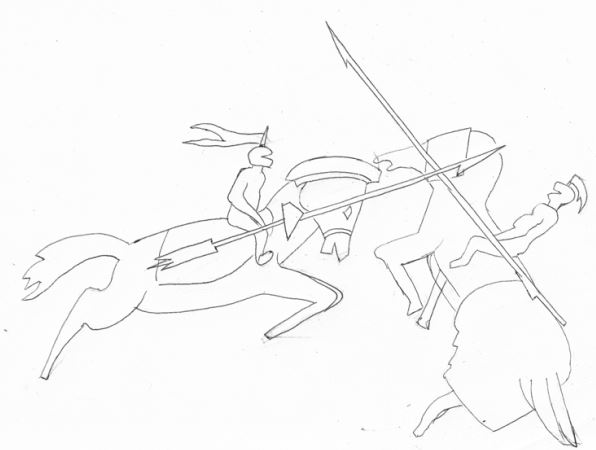
After brousing on the internet for inspiration, Addison Saxby came up with the idea of incorporating an emblem/symbol of two jousting horses. After opting to complete the drawing of our jousting ideas, I reseached many images and got my inspiration from two key photos: 


In drawing the logo I came up with this design: 
Subsequently, after handing this to Addison to incorporate into our chosen template, we faced some technical difficulties, and I was ask to recreate the image more simplicity and in bold black blocks. 
I then came up with this illustration:


Reasoning Behind Our Emblem

- The icon of jousting horses dates back hundreds of years, and links hand in hand with the aged look of the wooden board template, as well as our name AGE Productions. 

- Horses can be a vicious, wild, unrestrained animal which parallels to the wild, vilent, fiendish nature of our villains. The viollent action of jousting also pertains and foreshadows the action in our films. 

- Jousting nowdays is a sport/hobby, and this links to the entertainment factor that our film entails. 

- Jousting in ancient times was held between two opposising sides, and in jousting movies such as, A Night's Tale (2001), against good Vs bad/ hero Vs villain. Already from viewing our logo, our audience will percieve the coming coflict in polar characters, a convntion we make frequent use of.